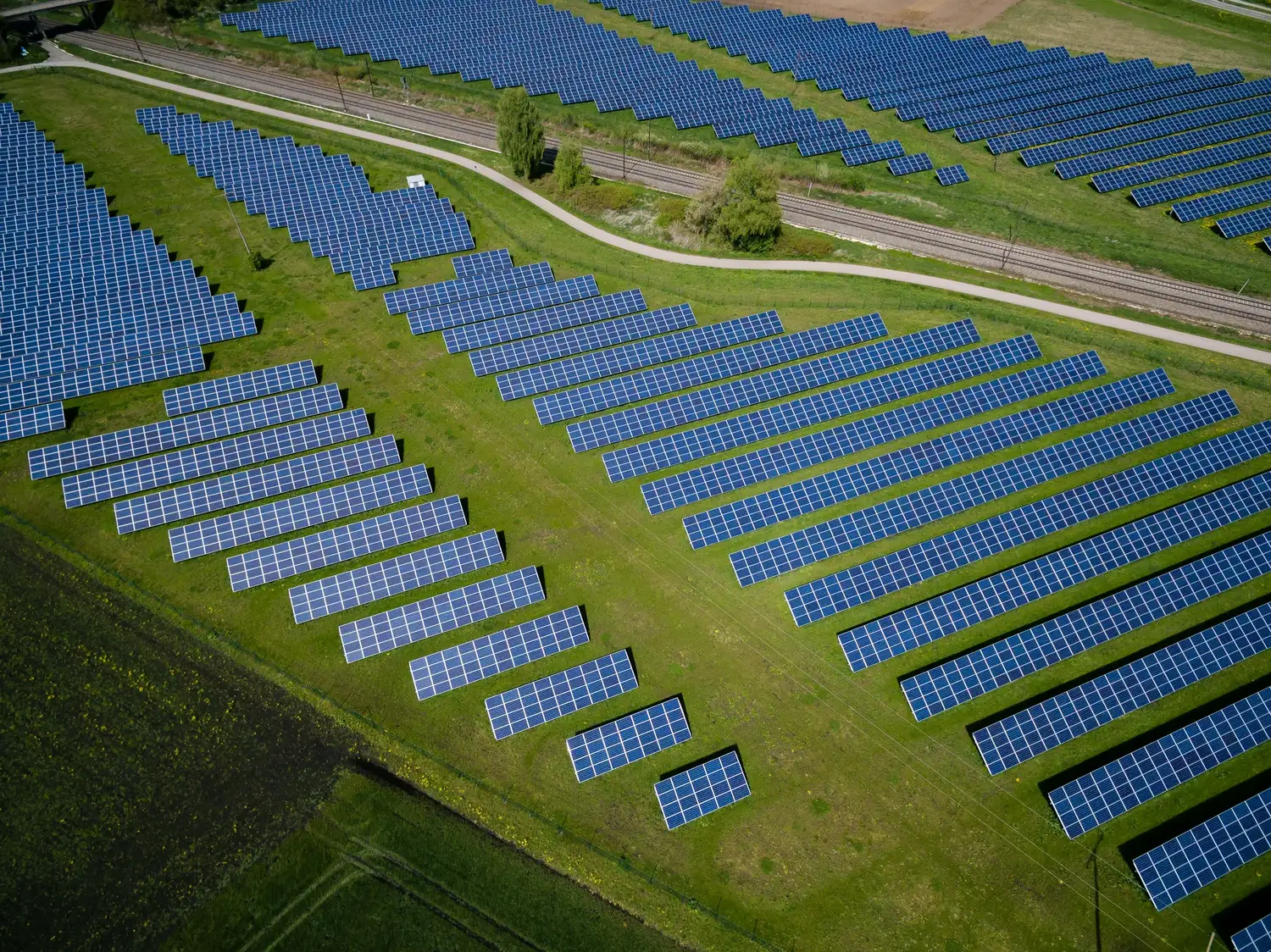
Solar farm investment means putting money into the land, grid connection, panels or companies that sell solar power. In the UK you can do it with a small amount through a listed fund or a crowdfunding platform, or with millions by buying a whole solar farm. A working solar farm earns a steady income for 35 to 40 years. The trade-off is that the biggest returns sit in the early stages, where most of the risk is too.
This is general information, not investment advice. Speak to a regulated financial adviser before investing.
Ways to invest in UK solar farms
There are seven main routes. The first three are open to anyone. The last four are for funds, companies and wealthy investors.
| Route | Typical amount | Risk |
|---|---|---|
| Listed solar funds | From the price of one share | Medium |
| Crowdfunding (bonds or loans) | Small amounts on some platforms | Medium to high |
| Community share offers | Often £250 to £20,000 | Medium to high |
| Buy a working solar farm | Hundreds of thousands to millions | Lower |
| Buy a ready-to-build project and build it | Millions | Medium |
| Fund development | Varies by site and stage | High |
| Co-develop with a developer | Shared costs | High |
1. Listed solar funds
These are investment companies on the London Stock Exchange that own working solar farms and pay out most of the income as dividends. You buy their shares through any share-dealing account or ISA.
They have had a hard few years. Share prices have sat well below the value of the farms they own (their net asset value, or NAV) for several years. In July 2026, NextEnergy Solar Fund’s shares traded close to 40% below its NAV. That gap has led to sales:
- Bluefield Solar Income Fund agreed a £548 million cash offer from Drax in June 2026, about 9% below its NAV. The deal completed on 31 July 2026.
- NextEnergy Solar Fund put itself up for sale in July 2026, saying the long-running discount had made it hard to raise money.
The useful point for anyone investing in solar: a trade buyer paid close to the book value of a large UK solar portfolio, even while the stock market was pricing these funds far lower.
2. Crowdfunding
Platforms such as Abundance let you lend to or invest in specific renewable projects, often with a low minimum. Returns are usually a set interest rate. Your money is tied up for the term, and it is not protected by the Financial Services Compensation Scheme if the project fails.
3. Community energy share offers
Community energy co-ops raise money from the public to build or buy local solar farms and wind turbines. Energy4All, for example, has helped co-ops raise more than £85 million, with most offers taking between £250 and £20,000 per person. You become a member, get one vote whatever you put in, and earn interest on your shares if the project performs.
4 to 7. Investing directly in solar farms
This is where we work. The stage you buy in at decides your risk and your return:
- Development (highest risk, highest upside). You pay for land options, grid applications, surveys and planning. If the site fails at grid or planning, most of that money is gone. If it succeeds, its value jumps at each stage.
- Ready-to-build. Land, grid offer and planning consent are in place. Value is much clearer. See what ready-to-build means.
- Construction. You take on cost and programme risk to build the farm.
- Operating. The lowest risk. You are buying a known income.
More detail: how solar farms are valued and how solar farms are bought and sold.
How a solar farm makes money
- Contracts for Difference (CfD). A government-backed fixed price for 20 years, rising with inflation. In the last round (AR7, February 2026), solar won about £65 per MWh in 2024 prices. The cap for the current round (AR8) is £75 per MWh, with results due between late November 2026 and February 2027.
- Power purchase agreements (PPAs). A fixed or partly fixed price agreed with a business or energy supplier, often for 10 years or more. See what is a solar PPA?
- Selling at market prices (merchant). Higher potential income, but prices move, and they drop when it is sunny because every solar farm is generating at once.
- Adding a battery. A battery on the same site can store cheap midday power and sell it later. See adding a battery to a solar farm.
More on this in energy trading explained.
How much does a 1MW solar farm make in the UK?
Roughly £65,000 to £70,000 a year from selling its power, at today’s CfD price. The working, using the government’s middle estimates for a new large solar farm:
- Output: about 1,000 to 1,070MWh per MW a year in the south of England.
- Price: about £65 per MWh, close to the AR7 CfD price.
- Running costs: about £9,300 per MW a year for maintenance, insurance and grid charges, plus land rent of about £4,500.
- Left over: about £50,000 per MW a year, before business rates, company costs, finance and tax.
- Build cost: about £660,000 per MW, so roughly 13 years to pay back from that income, before interest. See solar farm cost per MW.
The full worked example, with a 10MW farm and a table: how much do solar farms make in the UK?
A simple sum to show how it works, not a forecast. Real returns depend on the site, the contract and the cost of finance.
Solar farm profit per acre
A new UK solar farm needs about 4 to 5 acres per MW. On the same figures:
- The solar farm earns about £14,000 per acre a year in power sales. Most of that pays back the build cost and the loan.
- The landowner earns about £1,000 to £1,200 per acre a year in rent, usually linked to inflation, for 40 years or more.
So for most people, the highest-certainty way to profit from a solar farm is to own the land under it. See solar farm rent per acre.
Are solar farms a good investment?
They can be, for the right investor. In their favour:
- Long, steady income. Panels last 35 to 40 years, and a CfD fixes the price for 20 of them.
- Simple to run. No fuel to buy, few moving parts.
- Strong demand. Energy companies keep buying UK solar, as the Drax deal shows.
Against them:
- Your money is locked in for a long time. Except for listed funds, you usually cannot sell early.
- Returns are modest at the low-risk end. Big gains only come with development risk.
- Costs and rules change. Business rates, grid charges and power prices can all move against you.
The main risks
- Grid delays and cost. Connection dates can slip and quotes can rise. See why a pre-2030 grid date matters.
- Power prices. Unless the power is sold on a fixed contract. Prices can even go negative on sunny, windy days.
- Curtailment. Times when the farm is told to switch off.
- Build costs and interest rates. Both change the return a lot.
- Planning. At development stage, a refusal can end a project.
- Land. The lease must last as long as the project. See what to check in a solar farm lease.
- Business rates. Draft figures pointed to sharp rises for solar at the April 2026 revaluation.
- Panel wear. Output drops a little every year.
What to check before you invest
- A firm, early grid date at a sensible cost.
- Land rights of 40 years or more.
- A clean planning consent, with conditions you can meet.
- A fixed-price route to market, or a credible plan for one.
- Realistic output figures, based on the site, not a brochure.
- A developer who reports honestly, risks included.
Questions people ask
How much do you need to invest in a solar farm?
From the price of a single share in a listed fund, often a few hundred pounds through a community share offer, to around £660,000 per MW to build one yourself.
How long does a solar farm take to pay back?
On today’s figures, roughly 13 years from the power income alone, before interest and tax. A cheaper build, a better price or a battery shortens that.
Can I invest in a solar farm through an ISA?
You can hold shares in listed solar funds in a stocks and shares ISA. Some crowdfunding bonds can go in an Innovative Finance ISA. Check each offer.
How long does it take to build a solar farm?
From first look to switch-on is often 2 to 5 years, mostly waiting on grid and planning. Building it usually takes 3 to 9 months on site. See how long a solar farm takes.
Invest with us
We find land, secure the grid and run planning to ready-to-build, across the South West and the rest of the UK. You can fund development, co-develop with us, or buy at ready-to-build. Construction and operations are delivered with partners. Fund or co-develop solar projects →
Sources
- DESNZ / Arup: Renewable Energy Generation Cost and Technical Assumptions 2024 (July 2025)
- TaiyangNews: CfD Allocation Round 7 solar results (February 2026)
- Solar Power Portal: solar strike price stays at £75/MWh in AR8 (July 2026)
- Solar Power Portal: Drax buys Bluefield Solar Income Fund in £548 million deal (June 2026)
- Drax: acquisition of Bluefield Solar Income Fund completed
- AJ Bell: NextEnergy Solar Fund puts itself up for sale (July 2026)
- AIC: why NextEnergy Solar Fund put itself up for sale (July 2026)
- Ashden: Energy4All community share offers
- Hutton Institute: Energy4All has raised over £85 million for community co-ops
Facts last checked 3 November 2026. This is general information, not investment advice. The value of investments can go down as well as up. Speak to a regulated financial adviser before investing.