

Solar planning, handled in-house.
Our in-house Chartered Town Planner (MRTPI) takes solar, battery and wind projects from first site appraisal through to planning consent.
From first look to consent.
With the NSIP threshold now at 100MW, most solar schemes in England are decided by the local council. That's where we work.
Site appraisal
Early planning risk check covering policy, constraints, land grade, heritage and landscape, before you commit to options or grid.
Pre-application advice
We manage pre-app discussions with the local planning authority and EIA screening requests.
Full applications
Planning statements, design and access statements, and full coordination of ecology, LVIA, flood risk, glint and glare and heritage reports.
Conditions and appeals
Discharge of conditions after consent, and appeal support if an application is refused.
Appraise. Engage. Apply. Consent.
Appraise
We check the planning risks before you spend on options, grid or surveys.
Engage
We talk to the council early, through pre-app and EIA screening, so there are fewer surprises.
Apply
We write the application and coordinate every survey and report that goes with it.
Consent
We see it through to a decision, then discharge the conditions so you can build.
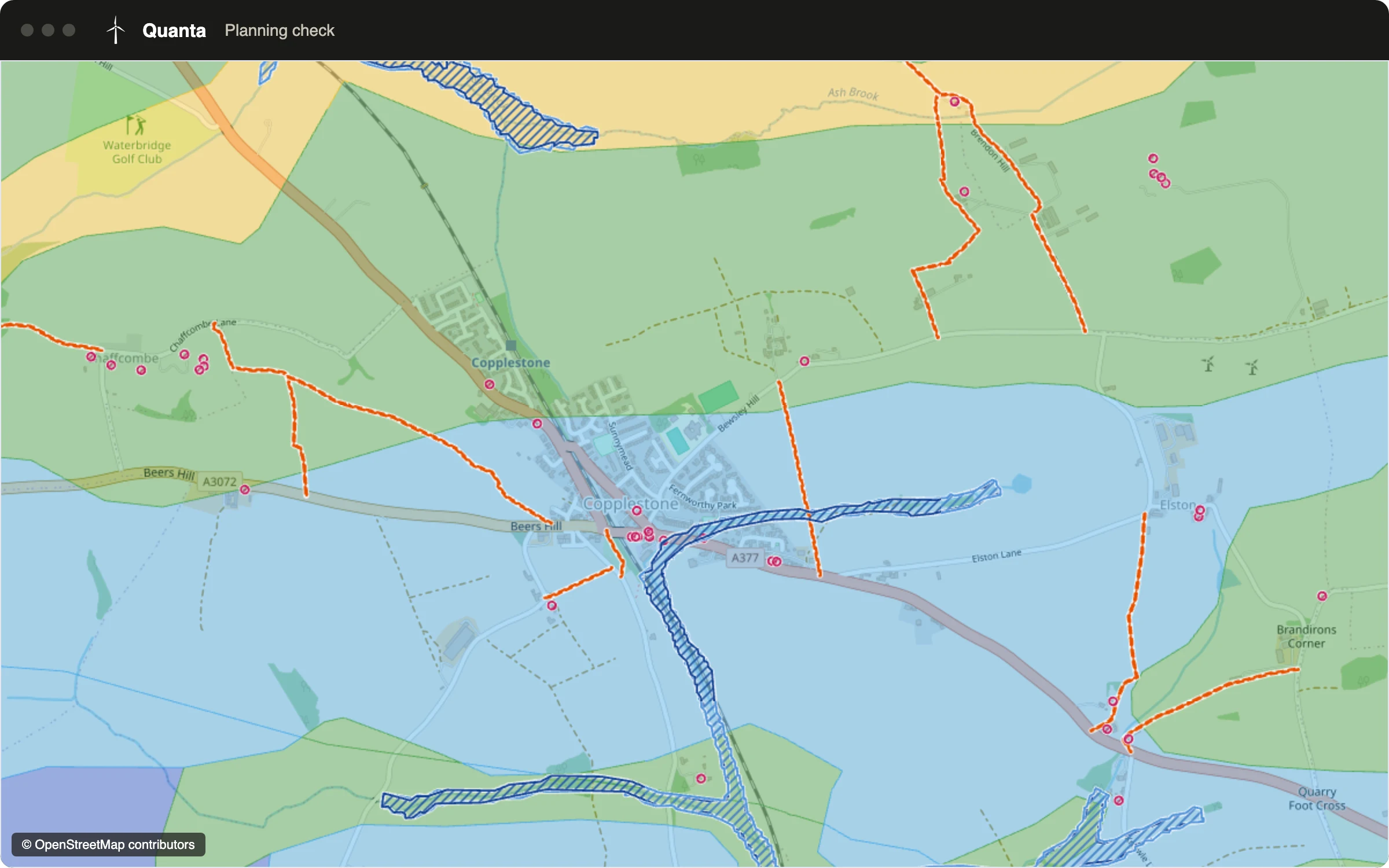
A real planning map from our software.
Planning risks, spotted early.
Every site we take on goes through our planning check first. You know the risks before you spend on options, grid or surveys.
- A planning verdict for every site
- See what's around the site at a glance
- Know how the local council treats solar
- Planning documents drafted, ready to review
Planning that fits the whole project.
Planning sits alongside land and grid in our development service. Because it's in-house, planning risks are checked from day one, not after the money has been spent.
Frequently asked questions
Does a solar farm need planning permission?
Yes. In England, solar farms up to 100MW need full planning permission from the local council. Larger schemes are Nationally Significant Infrastructure Projects (NSIPs) and are decided by the government instead.
Does battery storage need planning permission?
Yes. In England, battery storage projects are decided by the local council, whatever their size. We handle stand-alone batteries and batteries alongside solar.
How long does planning take for a solar farm?
Councils aim to decide major applications within 13 weeks, or 16 weeks if an Environmental Impact Assessment is needed. In practice it often takes longer, so good preparation and early talks with the council make a real difference.
What surveys does a solar planning application need?
It depends on the site, but most need ecology, landscape and visual impact (LVIA), flood risk, glint and glare, heritage and agricultural land quality. We coordinate them all so they arrive on time and tell one clear story.
Can you help if our application was refused?
Yes. We review the reasons for refusal and advise whether to appeal or submit a stronger application. If you appeal, we prepare and support the case.
Got a site that needs planning?
Tell us where it is and where you're up to. We'll tell you how we can help.