
Cheaper, cleaner power for your business.
Solar PPAs, private wire and large rooftop and ground-mount solar for businesses, farms and estates across the UK.
What we offer.
Pay upfront or pay nothing upfront. We find the option that fits your site, your bills and your budget.
Guides: Solar calculator · Solar PPAs · How installs work · Payback · System design · Fire safety · Export payments · Private wire · Microgrids · Off-grid in a city · Grants and tax relief · Batteries · Solar carports · Solar facades · Local: Exeter and Torbay
Solar PPA
No upfront cost. A funder pays for and owns the system on your roof or land. You buy the power it makes at an agreed rate, usually below what you pay now, for a fixed term. Best for sites with steady daytime use and a long lease.
Buy outright
You own the system and keep all the savings, plus any export income. The best long-term return if you have the budget, or can use asset finance.
Private wire
Power from a nearby solar farm sent straight to your site by cable, without going through the public grid. Suits large users with suitable land close by.
Rooftop solar
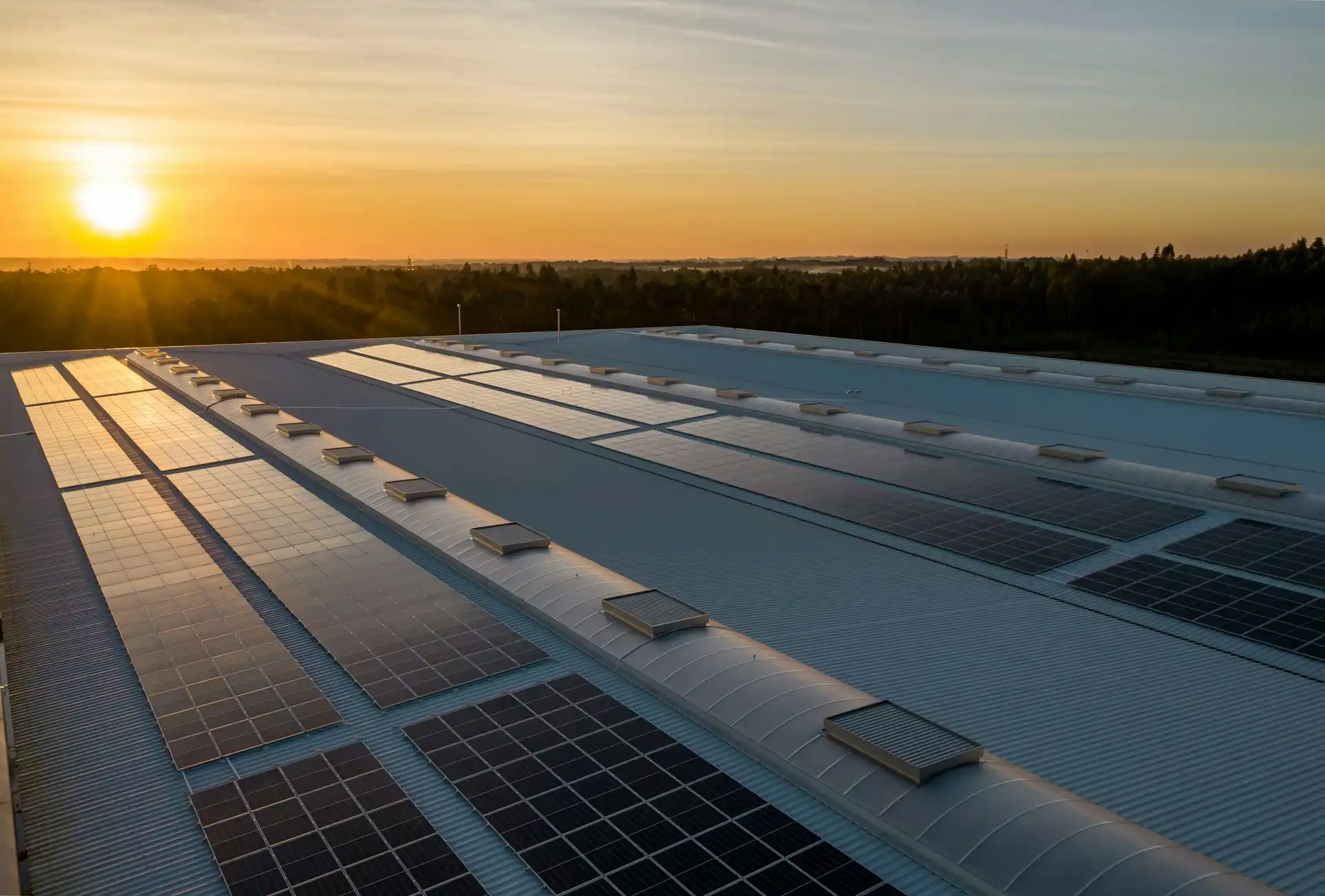
Large systems on factories, warehouses, barns, offices and schools. We check the roof structure and fire safety first, then design around how you use power.
Ground-mount solar
Arrays on spare land next to your site. Often more output than a roof, and our in-house planner handles the planning application.
Battery storage
Store solar or cheap night-time power and use it when prices peak. Can also help where the grid limits how much you can export.
Best for sites that use power in the day.
Factories and warehouses
Big roofs and high daytime use. Often the quickest payback.
Farms and estates
Barn roofs or spare land, running dairies, cold stores, workshops and pumps.
Offices, schools and public buildings
Daytime use that matches when solar generates.
Large users near open land
Private wire from a solar farm next door can cut costs further.
By business: Factories and warehouses · Cold stores and food businesses · Hotels and leisure · Schools and colleges · Farms and estates
One team, start to finish.
Most installers stop at the roof. We also handle planning and the grid connection in-house, so nothing stalls.
Site assessment
Your bills or half-hourly data, the roof or land, and the local grid, looked at together.
System design
Panel layout, yield and savings modelled for your site, with batteries and export limits where they help.
Planning
Permitted development, prior approval or a full application, handled by our in-house Chartered Town Planner (MRTPI).
Grid connection
The G99 application to the network operator, and any export limit agreed and set up.
Funding
Buy outright, use asset finance, or a PPA with no upfront cost. We explain each option in plain English.
Installation
Delivered with certified partner installers. We manage the job and stay your single point of contact.
Commissioning and handover
Tested, certified and signed off, with the paperwork, warranties and Smart Export Guarantee set up.
Aftercare
Monitoring, so you can see what the system is doing, and maintenance with partners if you want it.
From first call to first power.
Free call
Tell us about your site, your bills and what you want to achieve.
Site assessment
We look at your usage, the roof or land, and the local grid.
Proposal
A clear design, costs, savings and funding options, in plain English.
Planning and grid
We handle planning and the G99 application before any work starts.
Installation
Built by certified partner installers, managed by us.
Handover
Commissioned, certified and signed off, with monitoring set up.
What every installer should include.
Use this to compare quotes. If something is missing, ask why.
Structural check
A structural engineer confirms the roof can carry the panels and the wind load.
Building Control
The work is notified and signed off under the Building Regulations.
Asbestos check
Older roofs are surveyed for asbestos before anyone drills or walks on them.
RC62 fire safety design
Designed to RC62, the fire safety guidance insurers use for commercial rooftop solar.
CDM 2015
Health and safety planned and managed under the Construction (Design and Management) Regulations 2015.
BS 7671 certificate
An Electrical Installation Certificate to BS 7671, the UK wiring regulations.
G99 commissioning and export limiting
Network operator approval under G99, with commissioning and any export limit set and tested.
Smart Export Guarantee registration
Registered with an energy supplier, so you are paid for the power you export.
Fire isolation and labelling
Clear labels and isolation points, so firefighters can make the system safe.
Warranties in writing
Panel, inverter and workmanship warranties, written down and handed over.
Over 50kW? You don't need MCS.
MCS covers solar systems up to 50kW. For larger systems, up to 5MW, the installation still needs to be certified to a recognised standard to get Smart Export Guarantee payments, and your energy supplier decides how to check it. How export payments work →
The full installation process, step by step →
They still need G99 approval from the network operator, a BS 7671 certificate and good fire safety design.
Properly designed. Properly installed.
Installs delivered with certified partner installers. We design the system, manage the job and stay your point of contact.
- Installs
- Certified partner installers
- Company
- Quanta Renewables Ltd, Company No. 14875150
- Based in
- Exeter, Devon
Tell us about your site.
A few details are enough. We'll reply within one working day with honest advice and a clear next step.
Useful to have ready
- Your site address or postcode
- Your last 12 months of electricity bills, or half-hourly data if you have it
- Roughly how old the roof is, and any drawings you have
- Whether you own the building, or the length of your lease

Your enquiry comes straight to Charlie.Charlie Williams, founder, Quanta Renewables
Farm gates, CCTV or off-grid power? See farm and off-grid.
Commercial solar questions
Does commercial solar over 50kW need MCS?
No. MCS covers systems up to 50kW. For larger systems, up to 5MW, the installation still needs to be certified to a recognised standard to receive Smart Export Guarantee payments, and your energy supplier decides how to check it. They still need G99 approval, a BS 7671 certificate and good fire safety design.
What should a commercial solar installation include?
At least a structural check, Building Control sign-off, an asbestos check on older roofs, RC62 fire safety design, CDM 2015 compliance, a BS 7671 certificate, G99 commissioning and export limiting, Smart Export Guarantee registration, fire isolation and labelling, and written warranties.
What is a solar PPA?
A solar power purchase agreement (PPA) means a funder pays for the solar system on your roof or land. You buy the power it makes at an agreed price, usually lower than you pay now, for a fixed number of years.
Is there really no upfront cost with a PPA?
Yes. The funder pays for the system and its upkeep. You pay only for the power you use. It suits sites with high daytime use and a roof or land that is free for the long term.
What is private wire?
Private wire is a direct cable from a solar farm to a nearby business, so the power does not go through the public grid. It can work well for large users with suitable land close by.
Do I need planning permission for commercial solar panels?
Many rooftop systems on commercial buildings fall under permitted development, but there are limits and exceptions, such as listed buildings and some protected areas. Ground-mount systems more often need permission. We check this for you early.
Is solar worth it for my business?
Usually, if you use most of your power during the day. Businesses and farms often use solar power as it is made, which gives the best savings. We look at your bills and usage before recommending anything.
Can you add a battery to my existing solar panels?
In most cases, yes. We check your current system and usage, then size a battery that makes sense for how you use power.