
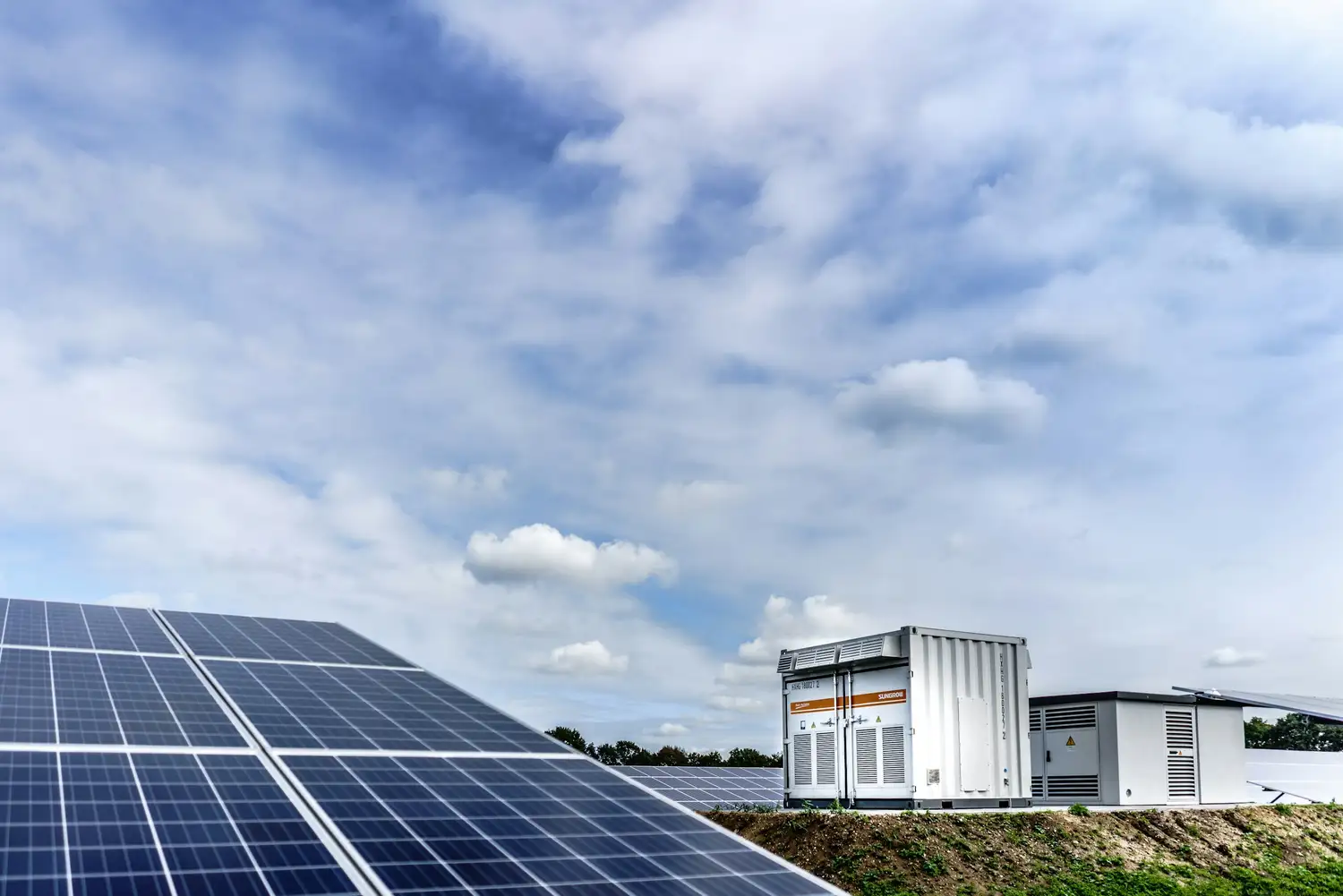
Battery storage for business is worth it when you have cheap power to store and expensive power to replace: spare solar you’d otherwise export for a few pence, or peak-time grid power at a high price. Installed business batteries are commonly quoted at around £200 to £800 per kWh, with smaller systems at the top of that range. Here is how to tell if the business case stacks up for your site.
What does a commercial battery do?
A battery stores electricity and releases it later. For a business, that can mean:
- Storing spare solar. Instead of exporting midday surplus for a few pence, you use it in the late afternoon and evening.
- Shifting to cheaper times. On a time-of-use tariff, you charge when power is cheap (often overnight) and use it at peak times.
- Cutting peak demand charges. Network charges are highest in the red band, usually late weekday afternoons and early evenings. The exact hours vary by region. A battery can cover your use in those hours.
- Staying within your supply capacity. If your site is close to its agreed capacity, a battery can trim the peaks. That may avoid excess capacity charges, or a costly grid upgrade.
- Backup power. Some systems can keep key circuits running in a power cut. Many can’t, so this must be designed in from the start.
- Earning from flexibility. Batteries can earn by helping the grid, for example by joining a virtual power plant (VPP). See also energy trading explained.
Battery storage for commercial solar
Batteries work best alongside solar when you export a lot. Businesses typically pay well over 20p per kWh for grid power, while export often earns 1p to 5p. Every kWh you store and use yourself instead is worth the difference.
A battery also helps if your network operator sets an export limit. With a zero export limit, spare solar is simply wasted unless you can use or store it.
How big a battery do you need?
The best starting point is your half-hourly data: your meter readings for every half hour over a year.
From it, we look at:
- How much solar you’d export on a typical day, through the seasons.
- How much you use in the evening and in the red band.
- Your peak demand compared with your agreed capacity.
A rough rule: size the battery to the smaller of your typical daily surplus and your typical evening use. A battery that’s bigger than either will sit half empty. Winter surplus is small, so a solar battery often does most of its work from spring to autumn, unless it also charges on cheap overnight power.
An illustration, not a quote: a site exports 150kWh of spare solar on a good summer day at 5p, and buys power in the evening at 25p. Storing it saves about 20p per kWh, so roughly £30 that day, less a little lost in charging and discharging.
That is why we design systems around your half-hourly data, not guesswork.
How much does a business battery cost?
| System size | Typical installed cost per kWh |
|---|---|
| Up to 50kWh | About £400 to £800 |
| Around 100kWh | About £200 to £400 |
| 200 to 500kWh | About £300 to £500 |
| 500kWh and up (containerised) | About £140 to £240 |
Budget ranges from a July 2026 UK cost guide that draws on industry sources.
Small systems cost more per kWh because fixed costs, such as the grid application, fire safety and commissioning, are spread over less storage. Prices have been falling. BloombergNEF’s December 2025 survey put the global average for large turnkey systems at US$117 per kWh, about 31% lower than a year before, with Europe higher at around US$177.
VAT: the 0% VAT rate on batteries is for homes and some charity buildings only. Businesses pay 20%, which VAT-registered businesses can normally reclaim.
The business case: what drives payback
- The price gap between when you charge and when you use the power. The bigger the gap, the better.
- How often it cycles. A battery that charges and empties most days pays back faster than one used now and then.
- The cost per kWh you pay for the system.
- Avoided costs, such as a grid upgrade you no longer need.
- Tax. Batteries are plant and machinery, so the Annual Investment Allowance (up to £1 million) can usually cover them. In England, plant that stores power from on-site renewables may also fall within the business rates exemption until March 2035. A battery that mainly charges from the grid may not. Ask your accountant or rates adviser.
- Wear and warranty. Batteries slowly lose capacity. Check the warranty in years, cycles and the capacity guaranteed at the end.
Is battery storage worth it for a small business?
It can be. Smaller batteries cost more per kWh, so the case is tighter, but the same tests apply at any size.
Often worth it if you:
- export a lot of solar at low rates,
- have an export limit or a zero export connection,
- are on a time-of-use tariff, or pay high red band charges,
- are close to your supply capacity,
- need backup for key equipment.
Often not worth it if you:
- already use nearly all your solar on site,
- use little power in the evening,
- are on a flat tariff with no peak charges,
- have no safe place to put it,
- may move site in the next few years.
Fire safety and insurers
Lithium-ion battery fires are rare, but serious. Good practice includes:
- A safe location, ideally outside or in a separate fire-rated room, away from escape routes and combustible stock.
- Detection and a battery management system that monitors temperature and shuts down faults.
- Following recognised guidance, such as the IET Code of Practice for Electrical Energy Storage Systems and RISCAuthority’s guide for commercial lithium-ion batteries. Larger outdoor systems of 1MWh or more are covered by fire chiefs’ (NFCC) guidance, updated in early 2026.
- Telling your insurer before you install. Insurers expect battery risks to be in your fire risk assessment, and may set conditions.
See also fire safety for commercial solar.
Planning and G99
- Planning. A battery inside an existing building often doesn’t need planning permission. An outdoor container or cabinet may, depending on its size and where it goes. Check with your council early.
- G99. A battery counts as generation. Most business batteries need approval from your network operator before they connect. If the local network is busy, an export limit can help get a yes. G99 explained.
What we do
We look at your half-hourly data, model solar and battery together, and show you whether a battery adds value on your site, or whether you’re better off without one. We handle the design and G99 application, and installs are delivered with certified partner installers. See commercial solar and batteries.
Get a free quote for your business →
Sources
- Reonic: commercial battery storage cost, 2026 UK guide (July 2026)
- Energy-Storage.news: battery storage system prices continue to fall sharply, BNEF and Ember reports find (December 2025)
- Catalyst Commercial: DUoS charges explained
- NFCC: grid scale energy storage system planning guidance
- HMRC: VAT on energy-saving materials (Notice 708/6)
- legislation.gov.uk: business rates exemption for on-site renewables (SI 2022/405)
Facts last checked 25 October 2026. Costs are budget ranges, not quotes. This is general information, not financial or tax advice.