
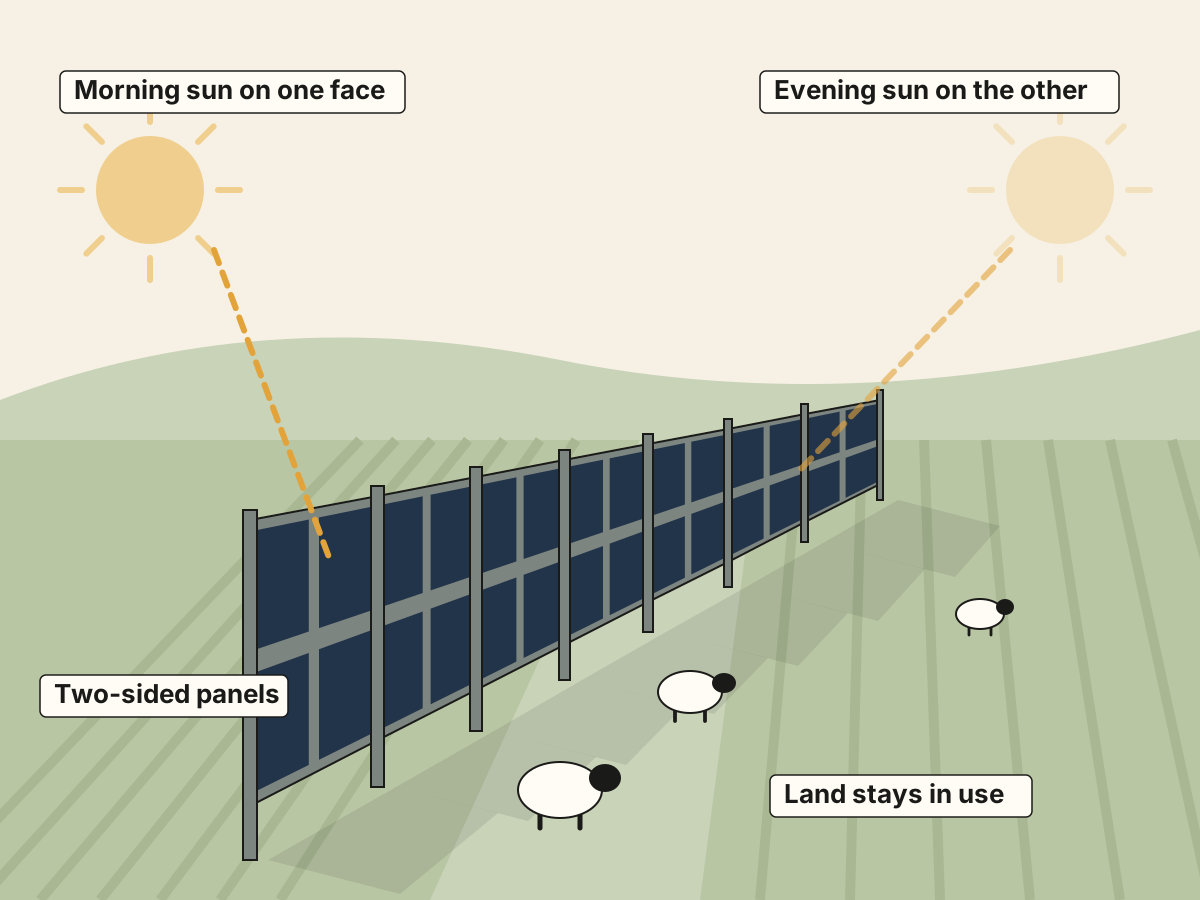
A fence that makes power, morning and evening.
Upright, two-sided solar panels for field boundaries, yards and site edges. We check it, consent it and manage the build, across the UK.
Five places an upright row earns its keep.
Vertical panels take a strip of ground about as wide as a fence. The land either side stays in use.
Field boundaries
A row along a north to south boundary does a fence's job and makes power as well.
Between crops
Rows set 8 to 15 metres apart leave wide strips that normal farm machinery can still work.
Grazing land
Sheep graze between the rows. Cattle and horses need fencing off, often electric, on both sides.
Yards, depots and car parks
Perimeter fencing for a business site, where the power is used in the buildings behind it.
Roads and railways
Solar noise barriers along a boundary that needs a screen anyway.
From one farm fence to 14 hectares.
Vertical solar is new here. We found no published working farm fence in Great Britain yet, so these three are from Ireland and the Continent.
These are not our projects. They are published examples from other farms and firms, shown so you can see the range. Each links to its source.
- 27kW150 metre fence
Kilmeaden Farm, Co. Waterford
Dairy farm, Ireland
Built in 2019 and timed to milking. An electric fence each side keeps the cows off.
Source: Farmers Weekly (opens in a new tab) - Research plotOne year of measurements
Aarhus University, Denmark
University field trial
Crops grew between the rows. Slightly less power a year than tilted panels, at more useful times.
Source: Aarhus University (opens in a new tab) - 4.1MWAbout 14 hectares
Donaueschingen-Aasen, Germany
Community-owned solar park
Roughly 11,000 two-sided panels in upright rows, expected to make around 4,850MWh a year.
Source: pv magazine (opens in a new tab)
Figures are as published by each source, checked 13 November 2026.
Four things to know before you start.
Vertical solar is not a way to get more power for less money. It is a way to get power at better times, from land you keep using.
About the same energy, or slightly less
Independent tests in northern Europe mostly show a little less energy a year than tilted, south-facing panels.
Better timing
The power comes in the morning and late afternoon, when many farms and businesses use more and midday prices are lowest.
It costs more per kW
One German study put a vertical farm system about 20 percent above standard ground-mount per kW, but less per hectare.
It nearly always needs planning
A solar fence on a boundary falls outside permitted development in England. We check the route before you spend.
Check. Design. Consent. Build.
Check
A quick, honest look at the line of the row, the shade either side, your power use and the grid supply.
Design
Row direction, height and spacing, yield through the day, budget cost and payback, set against tilted panels.
Consent and grid
The planning application and the G99 grid application, led by our in-house Chartered Town Planner (MRTPI).
Build
A managed build: posts, panels, cabling and handover, delivered with certified partner installers.
Solar fence questions
Do vertical solar panels make less power?
Over a year, about the same or slightly less per kW than tilted panels facing south. The difference is timing: the power comes in the morning and evening instead of at midday.
Which way should a solar fence face?
The row runs north to south, so one face points east and the other west. Hedges, trees or buildings close to either side cut the output a lot.
How tall is a solar fence?
A fence one panel high is about 1.2 to 1.6 metres. Two panels stacked is over 2 metres. Three-high farm rows reach about 4.5 metres.
Do I need planning permission for a solar fence?
In England, almost always yes. The permitted development right for stand-alone solar allows one small array, at least 5 metres from the boundary. A fence on the boundary falls outside it.
Can livestock graze beside vertical panels?
Sheep usually can. Cattle and horses need to be kept off the panels, normally with electric fencing on both sides.
How far apart are the rows?
For cropping, strips of 8 to 15 metres between rows are typical, so machinery can still work most of the field.
Are there solar fences working in the UK?
Very few have been published. The best-reported farm example nearby is a 27kW, 150 metre fence on a dairy farm in County Waterford, Ireland, built in 2019. Larger vertical solar parks are running in Germany.
How big can a vertical solar scheme be?
From a single fence run of a few kW up to a whole field. One German park of upright rows is rated at 4.1MW across about 14 hectares.
Are vertical panels better than tilted panels?
Only on the right site. They suit early and late power use, land you want to keep farming, or a boundary that needs a fence anyway. If you just want the most power for your money, tilted panels or a roof usually win.
Do you install solar fences yourselves?
We design the system, handle the planning and grid, and manage the build. The installation is delivered with certified partner installers.
Got a boundary and a power bill?
Tell us where it is and what the site uses. We'll check it and give you an honest answer.