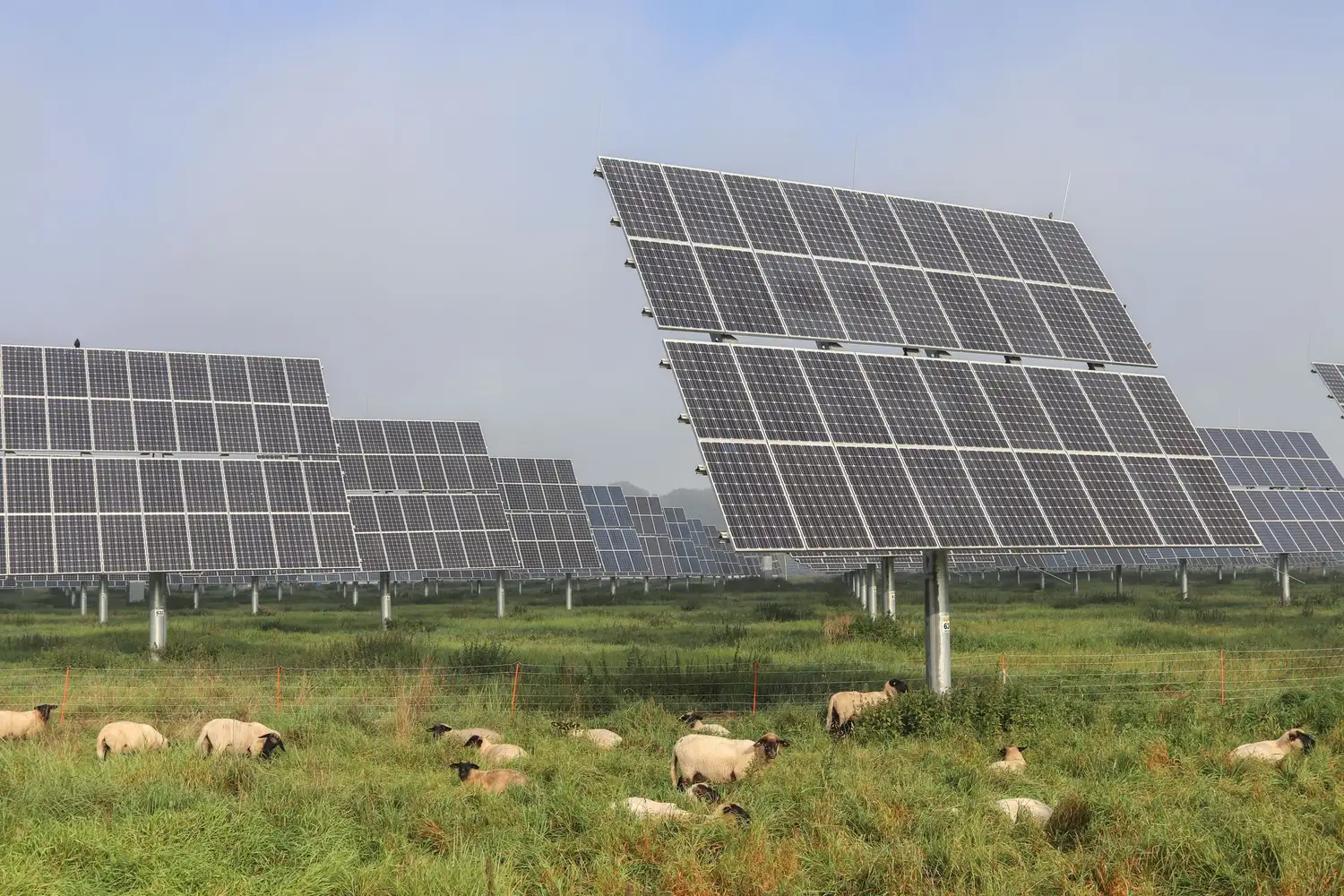
Agrivoltaics means using the same field for solar panels and farming at the same time. In the UK, agrivoltaics almost always means sheep grazing under the panels. Raised or vertical panels over crops are common in parts of Europe but still rare here. Here’s how it works, and what the rules say about solar panels on agricultural land in the UK.
What does agrivoltaics mean?
The word joins “agriculture” and “photovoltaics” (solar panels). The idea is simple: the land makes power and food, not one or the other.
There are three main types:
- Grazing under standard panels. Normal solar farm rows, with sheep grazing the grass between and under them.
- Raised panels. Panels on tall frames, high enough for crops, and sometimes machinery, to work underneath.
- Vertical panels. Upright rows of double-sided panels, facing east and west, with wide strips of crop between them. Vertical solar panels and solar fences.
There is no legal definition of agrivoltaics in the UK, and no separate planning rules for it. It is treated as a solar farm.
Sheep under solar panels: the UK norm
Most UK agrivoltaic projects are grazing schemes. A legal review in April 2025 counted around 15 commercial agrivoltaic projects in the UK, mostly small, and mainly involving sheep grazing and beekeeping, not crops.
Why sheep work well:
- They keep the grass down, so less mowing is needed.
- They are small enough to fit under the panels without damaging them.
- The land stays in farming use for the life of the solar farm.
- The farmer can earn twice: rent from the solar farm, plus a grazing income or lower grazing costs.
Things to agree in the lease:
- Who has the grazing rights, and whether it is you or a local grazier.
- Stocking numbers and timing, so the grass and wildflowers aren’t over-grazed.
- Access, gates, water and handling pens.
- Cattle, horses and pigs are not usually allowed, as they can damage panels, frames and cables.
What to check in a solar lease
Can you grow crops under solar panels in the UK?
You can, but very few UK farms do. Reasons:
- Less sunshine. UK light levels are lower than in southern Europe. Crops such as wheat need lots of light and tend to lose yield in shade.
- Higher cost. Tall frames need more steel and deeper foundations, so they cost more to build.
- Machinery. Combines and sprayers need wide, clear lanes. That means fewer panels per acre.
- No special support. The UK has no dedicated support scheme for agrivoltaics.
Where it may suit: soft fruit, salad crops and polytunnels, where some shade can help. A UKRI-funded project led by the University of Greenwich, with a Kent soft fruit grower, has tested solar panels built into polytunnels.
Biodiversity net gain
Since February 2024, most new solar farms in England that need planning permission must deliver a 10% biodiversity net gain. This means the site must leave wildlife better off than before, and the habitat must be looked after for 30 years.
For large projects consented as national infrastructure, the rule starts for new applications from 2 November 2026.
On a solar farm this usually means:
- Wildflower grassland under and between the panels.
- New hedgerows and field margins.
- Ponds, bird boxes, bat boxes and bee hives.
Grazing has to fit in with the habitat plan. Light, well-timed grazing can help a meadow. Heavy grazing can harm it. Agree the plan early.
Best and most versatile (BMV) land
Farmland in England is graded 1 to 5 under the Agricultural Land Classification (ALC).
| Grade | Quality | BMV? |
|---|---|---|
| 1 | Excellent | Yes |
| 2 | Very good | Yes |
| 3a | Good | Yes |
| 3b | Moderate | No |
| 4 | Poor | No |
| 5 | Very poor | No |
BMV land is grades 1, 2 and 3a. Solar on BMV land is not banned, but it is harder to get through planning. The council will want to know why poorer land nearby can’t be used, and will usually ask for a soil survey to confirm the grade. Which surveys a solar farm needs
What the government has said (2024 to 2026)
- May 2024: a ministerial statement said large solar farms should avoid BMV land where possible, using lower-grade land, brownfield and rooftops instead.
- Summer 2025: the Solar Roadmap kept planning protections for the best farmland. It said solar farms will take up less than 0.4% of UK land by 2030.
- March 2026: England’s first Land Use Framework said BMV land is to be safeguarded. It expects renewables to use about 1% of England’s land, and backs grazing under solar panels and agrivoltaics. Updated land classification maps are due later in 2026.
- August 2026: a new National Planning Policy Framework was published on 17 August 2026. It says planning decisions should take into account the quality of agricultural land, including BMV land and its grade, and use poorer land where possible. It lists the May 2024 statement as incorporated or superseded.
In short: the policy steers solar towards grade 3b, 4 and 5 land, but each site is judged on its merits.
Does solar affect my farm’s tax position?
It can. Land let for solar may lose agricultural property relief from inheritance tax, because it is no longer farmed in the usual way. Grazing may help, but it is not a guarantee. Speak to your accountant or solicitor early. More on rent and tax
What we do
We check your land for free, including the likely land grade, the grid and how much of it could take panels. We design sites with grazing and wildlife in mind from the start. Check your land for free → · Information for landowners →
Related: How much land do you need for a solar farm?
Sources
- CMS: expert guide to agrivoltaics in the UK (April 2025)
- University of Greenwich: solar panels to grow food, UKRI-funded project
- Defra: biodiversity net gain for major infrastructure projects (August 2026)
- NFU: Solar Roadmap published (July 2025)
- Farmers Weekly: 10 things farmers need to know about Defra’s land use plan (March 2026)
- GOV.UK: National Planning Policy Framework (August 2026)
Facts last checked 25 October 2026. Planning policy changes often, and every site is different. This is general information, not planning, tax or legal advice.