
Solar over the car park, power for the building beside it.
Solar carports for business, school, council and retail car parks, from a couple of dozen bays to a thousand. We design it, consent it and manage the build, across the UK.
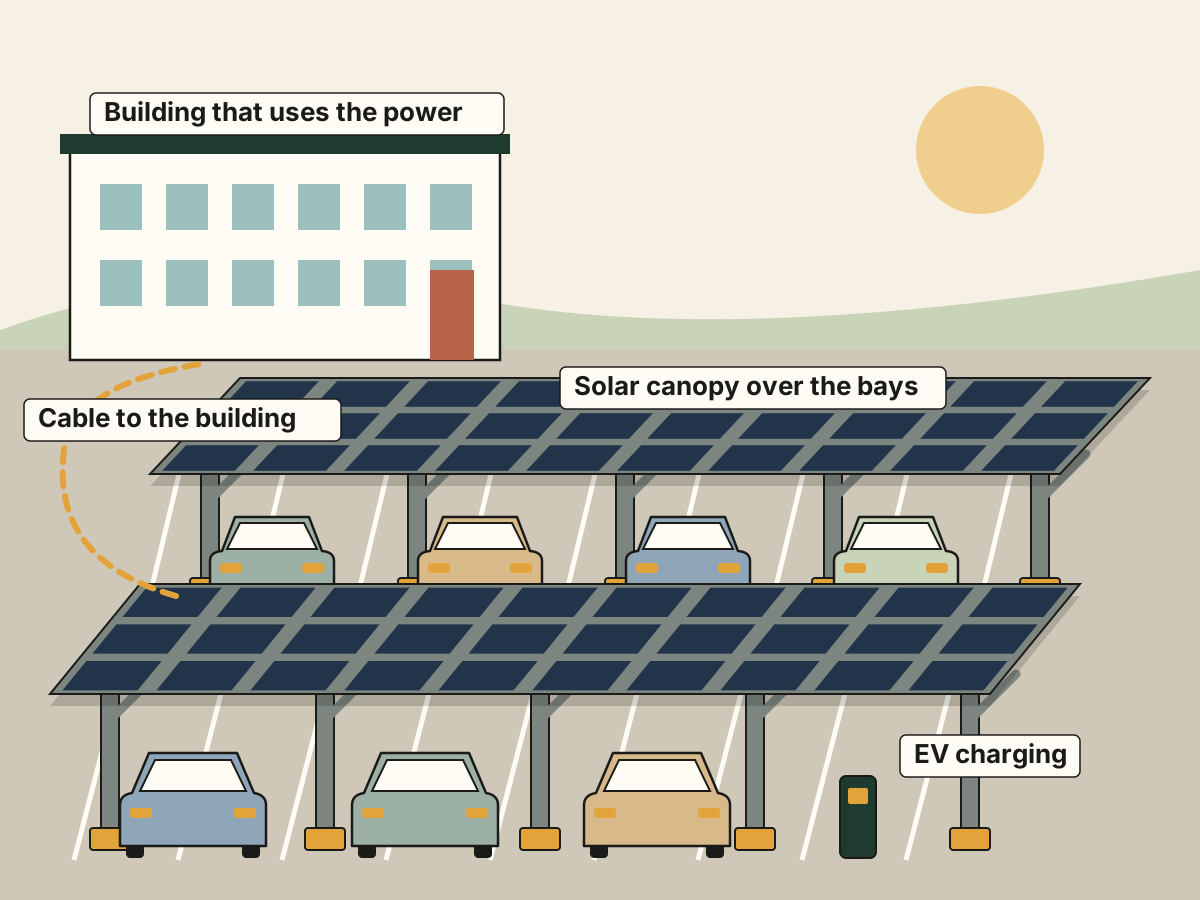
Four kinds of car park that suit solar.
Roof full, too weak or the wrong shape? If there is a car park outside and a power bill inside, the car park can do the work.
Offices and workplaces
Staff cars are parked all day, while the building is using power. The canopy feeds the building first.
Retail and leisure parks
Big, open car parks beside shops, gyms and hotels with a steady daytime bill. Shade and shelter for customers too.
Schools, hospitals and councils
Public car parks with a building beside them and a carbon target to meet.
Depots and fleets
Vans and pool cars that need charging. Solar overhead cuts the power you buy to charge them.
From 24 bays to 1,378.
A carport does not have to be huge to be worth doing. Here are six that are built and running in the UK, smallest first.
These are not our projects. They are published examples from other firms and councils, shown so you can see the range. Each links to its source.
- 62kWp24 bays
Heywood Sports Village, Rochdale
Borough council leisure centre
Switched on in June 2025.
Source: Polysolar (opens in a new tab) - 150kWpAbout 60 spaces
Bicester Leisure Centre, Oxfordshire
District council leisure centre
Expected to pay for itself in about 10 years.
Source: Solarsense (opens in a new tab) - Two 150kW systemsRoof level of each
Mary Arches and John Lewis car parks, Exeter
City council multi-storey car parks
Built in 2015 on top of two multi-storey car parks.
Source: The Exeter Daily (opens in a new tab) - 256kWpBays not published
Tewkesbury, Gloucestershire
Borough council
One canopy feeds both the leisure centre and the police station.
Source: Polysolar (opens in a new tab) - 1.2MWpBays not published
Stourton Park and Ride, Leeds
City council park and ride
Paired with a 950kWh battery and EV charging.
Source: EvoEnergy (opens in a new tab) - 2.7MW1,378 spaces
Bentley Motors, Crewe
Car factory staff car park
10,000 panels over the staff car park.
Source: Renewable Energy Magazine (opens in a new tab)
Figures are as published by each source, checked 13 November 2026.
Five things we look for.
A carport costs more than panels on a roof. It pays where the power is used on site. We will tell you plainly which side of that line your car park sits on.
A user beside the car park
A carport pays when the power is used on site. The more of it the building uses, the faster it pays back.
A roof that is full or unsuitable
A good roof is the cheaper place to start. A carport makes sense when the roof is full, too weak or the wrong shape.
Room on the grid supply
We check the existing connection first. EV chargers can need a bigger one; solar and a battery can keep the peak down.
Open bays, away from houses
In England, canopies up to 4 metres high and more than 10 metres from homes can use the quicker prior approval route.
A plan for EV charging
Not needed on day one. But laying the cable ducts during the groundworks is far cheaper than digging twice.
Check. Design. Consent. Build.
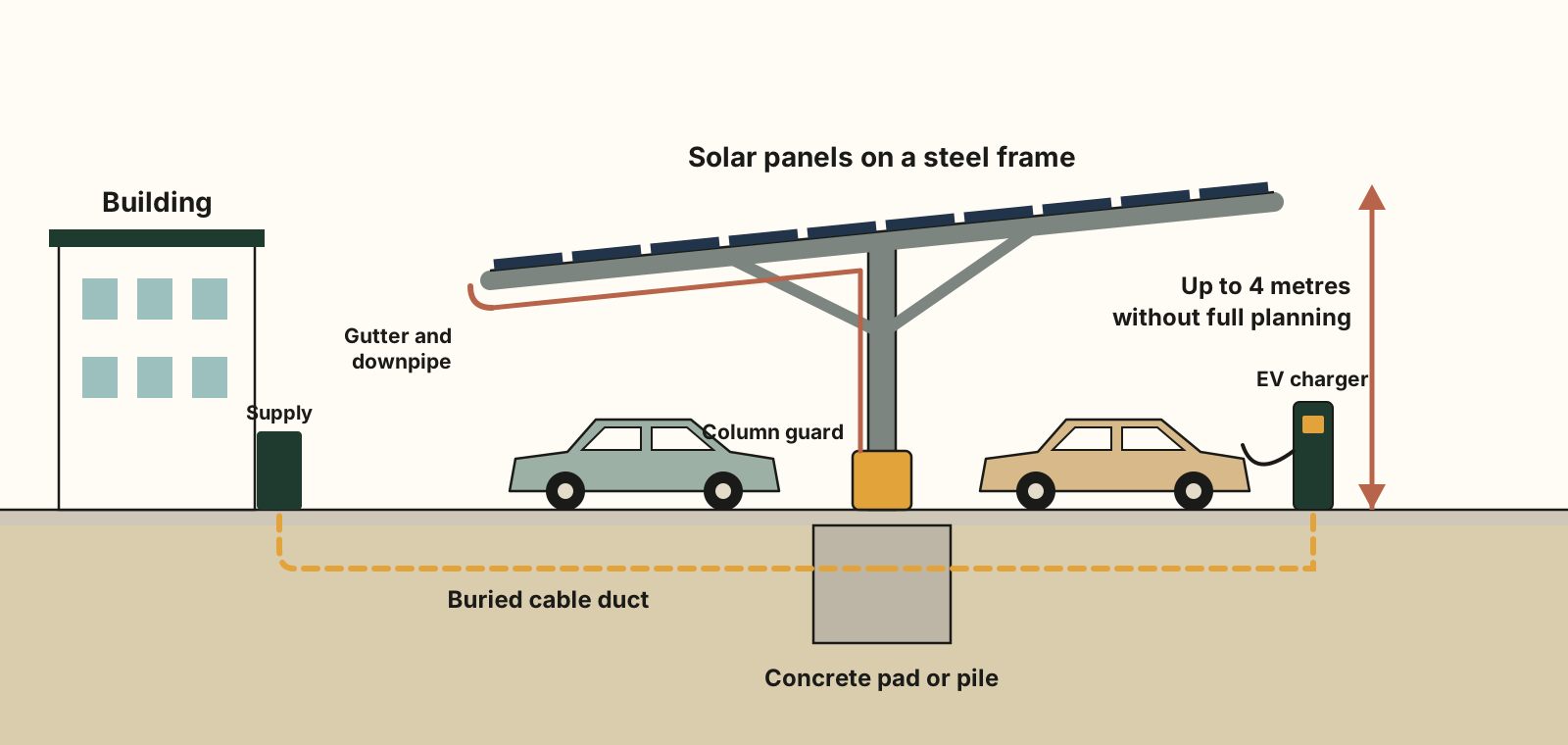
Check
A quick, honest look at the car park, your power use and the grid supply. If a roof would pay better, we say so.
Design
Canopy layout, size and yield from your half-hourly data, with budget cost and payback, EV charging and battery options.
Consent and grid
Prior approval or planning, and the G99 grid application, led by our in-house Chartered Town Planner (MRTPI).
Build
A managed build in phases, so most of the car park stays open. Installed with certified partner installers.
Solar carport questions
How much does a solar carport cost?
Published UK figures put solar carports at roughly £900 to £2,200 per kWp, or about £6,000 to £12,000 per parking bay. That is more than rooftop solar, because of the steel frame and foundations.
Does a solar carport need planning permission?
In England, often not full planning permission. A canopy over a non-domestic car park can be permitted development if it is no more than 4 metres high and at least 10 metres from homes. It still needs prior approval from the council, which has 56 days to decide.
What is the smallest solar carport worth building?
Published UK examples start at around 24 bays and 60kWp. Smaller canopies can be built, but the steel and groundworks cost more per kWp on a small site, so the power needs to be used on site for it to pay.
How big can a solar carport be?
The largest published UK example covers 1,378 spaces and is rated at 2.7MW. On most sites the limit is not the car park. It is the grid connection and how much power the buildings can use.
Can a solar carport go on a multi-storey car park?
Yes. Exeter City Council put solar canopies on top of two multi-storey car parks in 2015. A structural engineer has to check the structure can take the extra load and wind.
Can one carport supply more than one building?
Yes, if the buildings are close and the wiring is agreed. One council canopy in Tewkesbury feeds the leisure centre and the police station beside it.
Can a solar carport be built with no upfront cost?
Often, yes. Under a power purchase agreement a funder pays for and owns the carport, and you buy the power it makes at an agreed price. It suits larger car parks with a steady daytime load.
How much power does a solar carport make?
Each parking space takes roughly 2 to 3kWp of panels, depending on the layout. So a 50-space car park could hold around 100 to 150kWp.
How long does a solar carport take to pay back?
Longer than rooftop solar. In one council study of seven car parks, sites that used around 90 percent of the power on site broke even in 9 to 11 years. Sites that used much less took 13 to 16 years.
Can a solar carport power EV chargers?
Yes. Cars that charge in the day use the solar directly. A battery can store the midday surplus for evening charging, and helps where the grid supply is limited.
Will the car park have to close during the build?
Not all of it. Carports are built in sections, so most bays stay open while each row goes up.
Do you install solar carports yourselves?
We design the system, handle the consent and grid, and manage the build. The installation is delivered with certified partner installers.
Got a car park and a power bill?
Tell us where it is and what the building uses. We'll check it and give you an honest answer.