
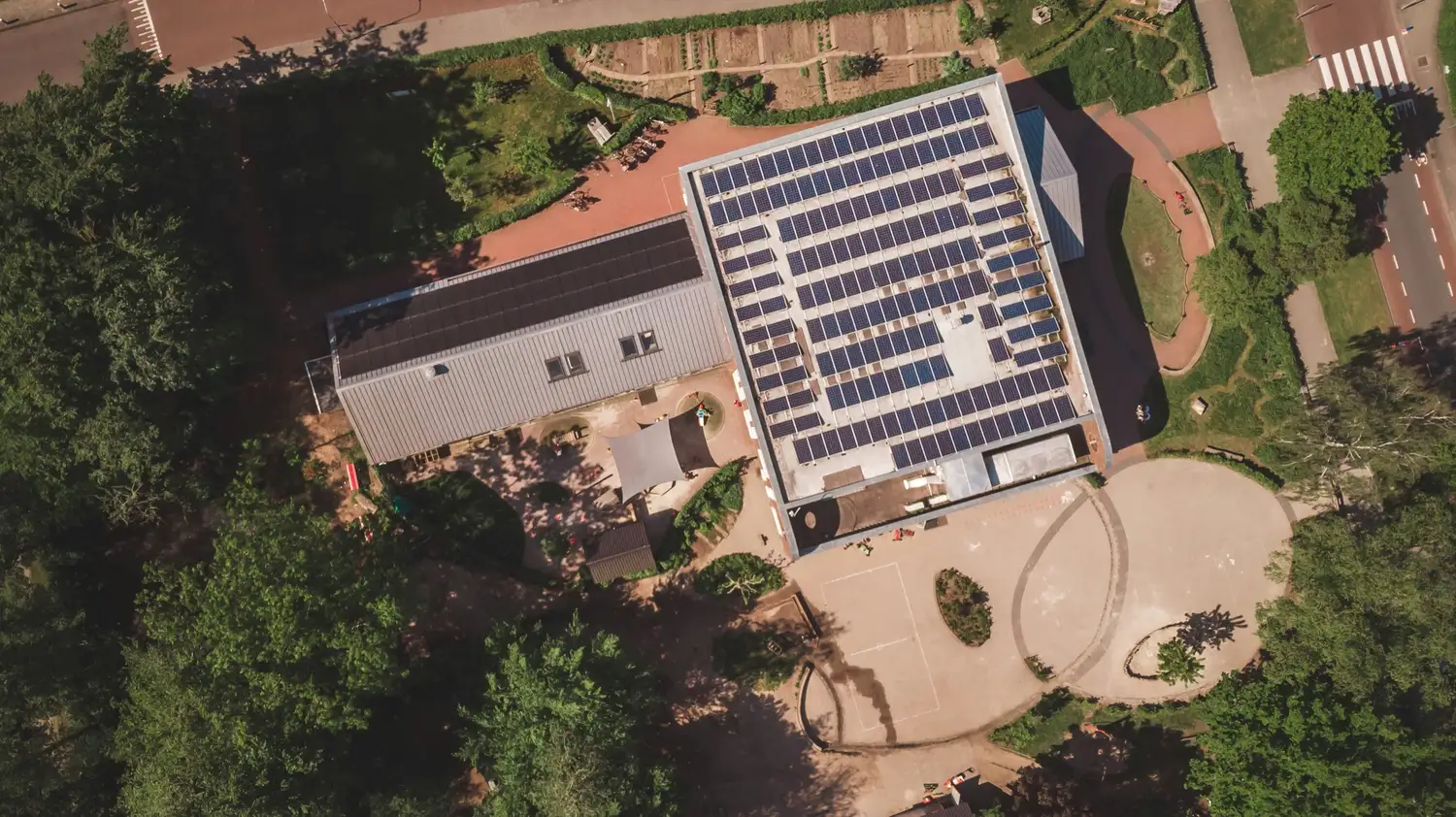
A solar carport is a steel canopy over parking bays with solar panels for a roof. In the UK, published figures put solar carports at roughly £900 to £2,200 per kWp, more than rooftop solar because of the steel and foundations. In England, most canopies over business car parks don’t need full planning permission, but they do need prior approval from the council first.
What is a solar carport?
It’s a frame of columns and beams, open at the sides, with panels on top. Some cover one row of bays. Others span two rows from a central column.
It does three jobs at once:
- Makes power for the building, the car park or EV chargers.
- Shelters cars and people from sun, rain and snow.
- Carries the cabling for chargers, lighting and CCTV.
Solar carports suit businesses, schools, councils, hospitals, retail parks and leisure centres. They are a good option when the roof is full, too weak or the wrong shape. Depending on layout, each parking space takes roughly 2 to 3kWp of panels.
How much does a solar carport cost?
Prices vary with size, design and ground conditions. Here are published UK figures:
| Source | Figure |
|---|---|
| Installer guide (Reonic, August 2026) | £900 to £1,400 per kWp at commercial scale. £1,200 to £3,000 on small or complex sites. Roughly £6,000 to £12,000 per bay all-in |
| Community energy group (Sharenergy, 2025) | £1,900 to £2,200 per kW, or £6,000 to £7,000 per space. Excludes grid connection and EV chargers |
| Council feasibility study (Three Rivers, 2025) | £2,000 per kW baseline. £4,000 per kW at sites with costly grid connections |
| Rooftop solar, for comparison (Sharenergy, 2025) | £750 to £1,000 per kW |
Why carports cost more than rooftop: the steel frame, foundations, groundworks, cranes and structural design. Reonic puts steel and foundations at around 45% of the cost.
When you compare quotes, check what’s in them: VAT, EV chargers, grid upgrades, resurfacing, lighting and drainage can all be extra.
Do you need planning permission for a solar carport?
In England, often not full planning permission. Since 21 December 2023, a solar canopy over a non-domestic car park can be permitted development under Class OA of Part 14 of the General Permitted Development Order.
Unlike small rooftop systems, every Class OA canopy needs prior approval. The council looks at siting, design and appearance, especially glare for neighbours. In a conservation area or other protected landscape, it also looks at the effect on that area. The council has 56 days to decide.
The limits:
- No more than 4 metres high.
- Not within 10 metres of the boundary of a house or block of flats.
- Open on all sides, or three sides if it adjoins a building.
- Not allowed for homes or flats, within the grounds of a listed building, or on a scheduled monument.
- Drainage: over a permeable surface, rainwater must run to a permeable area within the car park.
- Finish within 3 years of approval.
You’ll need full planning permission if the canopy is taller (for vans, lorries or coaches), close to houses, or near a listed building. Wales and Scotland have their own rules.
The government asked in 2025 whether solar canopies should be compulsory on new car parks. In May 2026 it said it would not take that forward.
Solar carports with EV charging
Solar and EV charging fit well together. Staff and fleet cars often charge in the day, when the panels are working.
- Plan the ducting now. Lay cable routes for chargers during the groundworks, even if you add chargers later.
- Watch the grid. Lots of chargers can need a bigger connection. Solar, a battery and smart load management can reduce the peak you draw.
- Grants. The Workplace Charging Scheme pays up to £500 per socket (up to 75% of costs) for up to 40 sockets. It is open until 31 March 2027. State-funded schools have their own version.
Solar carports with battery storage
A battery stores the midday surplus for later. That helps if:
- cars charge in the evening or overnight,
- you pay more for power at peak times,
- your export to the grid is limited,
- or rapid chargers create short, high peaks.
A battery that can export needs G99 approval from the network operator, the same as the solar.
Groundworks and drainage
Most of the work happens below the surface.
- Services survey. Find buried cables and pipes before any digging or piling.
- Foundations. Usually concrete pads or piles. Ground screws can work on some sites.
- Trenching. Cables run from each canopy to your switchroom.
- Drainage. A canopy gathers rain and drops it in lines. Plan gutters, downpipes and where the water goes.
- Phasing. Build in sections so most of the car park stays open.
Solar carport design: structural and fire points
- Structural design. A structural engineer designs the frame for wind and snow loads at your site.
- Vehicle impact. Protect columns with kerbs or bollards, and sign the clearance height.
- Lighting and CCTV. Canopies make shade. Fit lighting underneath so the car park feels safe.
- Fire. Plan the layout, cable routes, isolation switches and fire service access, and talk to your insurer early. Commercial solar fire safety.
Payback compared with rooftop
Rooftop solar for a business that uses most of its power in the day often pays back in around 4 to 8 years. How payback works.
Carports cost more, so payback is usually longer. In the Three Rivers study, seven council car parks broke even in 9 to 16 years. The sites that used around 90% of the solar on site broke even in 9 to 11 years. Those that used much less, or had costly grid connections, took 13 to 16 years.
So the same rule applies: use as much of the power on site as you can. If you have a good roof, it is usually the cheaper place to start. A carport makes sense when the roof is full or unsuitable, or when you also want shade and EV charging. How we design a system.
The panels may qualify for capital allowances, but the steel structure may be treated differently. Ask your accountant.
What we do
We design solar carports around your half-hourly data, check the planning route and grid, and handle prior approval and G99. Installs are delivered with certified partner installers.
Solar carports: what we do → · Get a quote → · Commercial solar →
Sources
- legislation.gov.uk: GPDO 2015, Schedule 2, Part 14 (Class OA solar canopies)
- Three Rivers District Council: solar canopy feasibility study summary (January 2025)
- Sharenergy: solar canopies and community energy (May 2025)
- Reonic: solar carport guide (August 2026)
- CPRE: government drops plans for solar on new car parks (May 2026)
- GOV.UK Find a grant: Workplace Charging Scheme
Facts last checked 25 October 2026. Costs vary by site. This is general information, not planning, tax or financial advice.