
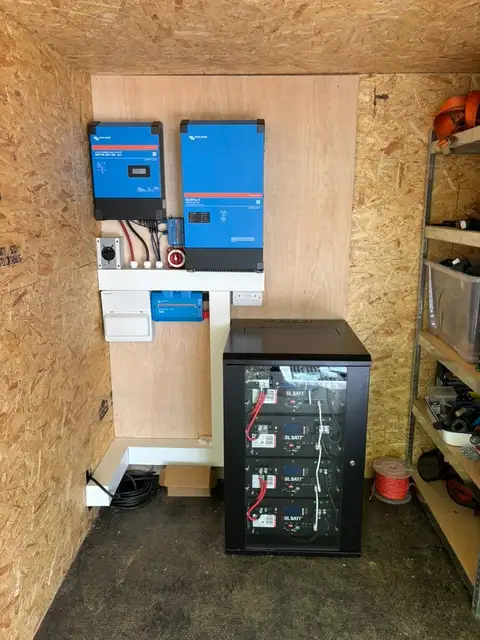
Yes, going off-grid in the city can be done, for the right building. A low-rise building with a big roof and modest power use, such as a single-storey workshop, can make more electricity in a year than it uses, even with a heat pump, from its own roof. What it takes is every sunny surface covered, demand cut first, a battery sized for winter and a clean backup for dark weeks.
Which buildings can go off-grid?
The test is simple: how much roof you have compared with how much floor you power. Roof space stays the same as a building gets taller. Floor space, and power use, keeps growing.
Good candidates: single-storey workshops, warehouses and storage units, small offices, studios and some shops. Low and wide, with modest use.
Poor candidates: multi-storey offices and blocks of flats. Lots of floors, one roof.
A worked example
Each building below has a 1,000m² roof. We assume about 0.15kWp of solar per m² of roof, so 150kWp. In central London, a south-facing roof makes about 1,025kWh per kWp a year, so roughly 150,000kWh. December makes less than a third of June: about 37kWh per kWp against 123kWh.
Power use comes from CIBSE’s TM46 benchmarks, per m² of floor a year: 35kWh of electricity for a workshop and 95kWh for a general office. Use is spread evenly through the year for simplicity.
| Building | Yearly electricity use | Roof solar covers (year) | Roof solar covers (December) |
|---|---|---|---|
| Single-storey workshop, 1,000m² | 35,000kWh | about 430% | about 190% |
| Single-storey office, 1,000m² | 95,000kWh | about 160% | about 70% |
| Six-storey office, 6,000m² | 570,000kWh | about 26% | about 12% |
The workshop can do it, with room to spare. The single-storey office covers its year but falls short in winter. The six-storey office can’t get close from its roof.
One catch: TM46 also gives a workshop 180kWh per m² of heat from gas or oil. Move that onto a heat pump and winter demand jumps. That’s why insulation comes first.
What it takes to go off-grid in the city
1. Use every surface
The roof is just the start. In a city, look at:
- Walls. South-facing vertical panels make less over a year, about 750kWh per kWp in London, but hold up well in winter: about 45kWh per kWp in December against 63kWh in June.
- The building itself. Solar built into roofs and facades replaces cladding.
- The car park. A solar carport adds generation and shade.
2. Cut demand first
Every kWh you don’t use is one you don’t have to make and store. LED lighting, efficient kit, good insulation and a heat pump instead of gas all shrink the system you need.
3. A battery sized for winter
Summer is easy. The battery has to carry you through short, dull December days, so size it for winter, not for a sunny afternoon. Battery storage for business covers costs and fire safety.
4. A smart energy system
Off-grid, an inverter and control system run the whole building: charging, load priorities and switching to backup. Our Victron off-grid guide shows how this works.
5. A clean backup for dark weeks
Even a well-designed off-grid building needs something for a long grey spell. City options include:
- HVO generators. HVO is a renewable diesel substitute. The Environment Agency says its NOx is similar to diesel, with lower CO2 and particulates. It’s still burned, so air quality rules still apply.
- Gas or hydrogen generators, or more battery. In one 2025 City of London planning case, the council asked the developer to look at battery backup and gas or hydrogen generators before any diesel.
What makes it hard
- Winter. December solar is a fraction of June. The gap is what drives battery size, cost and backup.
- Space. Tall buildings run out of roof long before they run out of floors.
- Backup rules. In the same City of London case, the generator could only run in a life-threatening emergency and for testing. Large plant may also need chimney height approval under the Clean Air Act 1993. Generators between 1MW and 50MW may need an environmental permit. In a city, routine generator use is hard to get approved.
- Battery safety. Batteries inside buildings need careful siting. PAS 63100 covers homes. For business premises, follow RISCAuthority guidance and tell your insurer first. See commercial solar fire safety.
- Planning. Rooftop solar is usually permitted development, sometimes with a prior approval step. Conservation areas and listed buildings have tighter rules. See prior approval for rooftop solar.
- Cost. A fully off-grid system costs more than solar and battery with a grid connection, because you’re paying for winter.
Real examples
Brütten, Switzerland: a fully off-grid block of flats
The world’s first energy-self-sufficient block of flats is in Brütten, near Zurich. Nine homes moved in from summer 2016 with no external energy connection. Around 1,000m² of solar on the roof and facade makes about 88,000kWh a year. Batteries cover the short term and hydrogen stores summer power for winter.
It worked. In 2019 it got a grid connection, but only to export its surplus: about 15,000kWh in 2021.
Closer to home: UK steps on the way
None of these is fully off-grid, but each shows a piece of the puzzle working in a UK town or city.
- Woking town centre. Since 1999 the council’s energy company, ThamesWey, has run a gas CHP station that sends power down its own private wire to buildings in the town centre, including the civic offices, a hotel, the leisure centre and WWF-UK’s headquarters. ThamesWey calls it the UK’s first CHP multi-customer private wire network. It shows a town centre can share its own power across many buildings.
- Repowering London. It grew out of Brixton Energy, founded in 2011, which put community-owned solar on the roofs of the Loughborough and Roupell Park estates in south London. It now has more than a dozen schemes. Local people invest, and surplus income goes into a community fund for local groups.
- GeoPura hydrogen power units. These replace diesel generators. In 2022 HS2 trialled two 250kVA units on a site in Ealing, west London. HS2 said they were quieter than diesel, gave off only water and saved about 51 tonnes of carbon over 400 hours. A unit like this is one option for the clean backup an off-grid city building needs.
Not quite ready to cut the cord?
Most city sites get most of the benefit by being grid-independent, not off-grid. These are steps on the way:
- Island-mode backup. Solar and battery that keep key loads running in a power cut, with the grid there the rest of the time.
- Private wire. Power from a solar roof or car park cabled to a neighbour. See what is private wire?
- Urban microgrids. Campuses, hospitals, universities, business parks and regeneration sites sharing generation and storage across buildings. See what is a microgrid?
- Community schemes. Community energy groups and clubs that match local generation with local use. In August 2026 Ofgem sent back P441, a code change that would help schemes net local generation against local use, for timetable alignment with two related changes. It is not in force yet.
- EV charging hubs with batteries, so chargers don’t need a bigger grid connection.
Selling power to neighbours needs a supply licence or an exemption, and anything connected to the grid needs G99 approval. Take legal advice. See how to apply for a grid connection.
When does it make sense?
- Critical loads that can’t go down.
- Sites waiting years for a grid upgrade.
- New builds with a small or slow grid connection.
- Campuses with many buildings on one site.
- Low-rise buildings with big roofs and modest use, where full off-grid is realistic.
What we do
We design commercial solar, batteries, private wire and microgrids, and handle planning and the grid connection. We’ll tell you honestly whether your building can go off-grid or should stay connected. Installs are delivered with certified partner installers.
Commercial solar → · Try our solar calculator →
Sources
- EU JRC: PVGIS solar estimates for London (35° and vertical, south-facing)
- CIBSE TM46 energy benchmarks, Table 1 (via GreenCalculus)
- City of London: environmental comments on generators, 319–325 High Holborn (January 2025)
- Environment Agency: permit decision allowing HVO in back-up generators (December 2023)
- Umwelt Arena: five years of the energy-self-sufficient apartment building, Brütten (February 2022, German)
- ThamesWey: Woking town centre energy station
- OnLondon: Repowering London, green energy from the grassroots (April 2024)
- HS2: results of the hydrogen generator trial (July 2022)
- Ofgem: P441 send-back letter (August 2026)
Facts last checked 26 October 2026. Figures are illustrations, not a design. This is general information, not legal advice.