
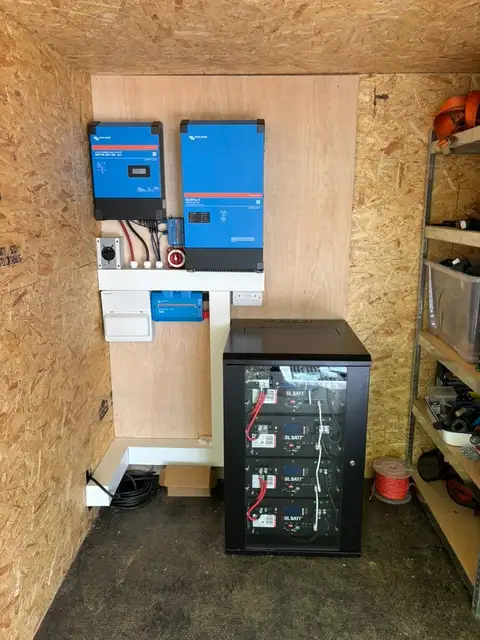
An off-grid solar system in the UK runs a barn, workshop, yard or holiday let with no grid connection: panels charge a battery, and an inverter turns that into normal mains power. The big design issue is winter. In Devon, a panel makes only about a quarter as much power in December as in June, so most UK off-grid systems also need a backup generator.
What’s in an off-grid solar system?
| Part | What it does |
|---|---|
| Solar panels | Turn daylight into DC (battery-type) electricity. |
| MPPT solar charge controller | Gets the most out of the panels and charges the battery safely. |
| Battery | Stores power for the night and for dull days. |
| Inverter/charger | Turns battery power into 230V mains power. It can also charge the battery from a generator. Victron’s MultiPlus and Quattro are common examples. |
| Monitoring | A Victron Cerbo GX shows battery level and solar output. It links to Victron’s free VRM website, so you can check the system from your phone. |
| Backup generator | Tops the battery up in long dull spells, usually in winter. |
LiFePO4 or lead-acid?
- LiFePO4 (lithium iron phosphate) is now the usual choice. Victron rates its Lithium Smart batteries at 2,500 cycles at 80% depth of discharge. Depth of discharge is how much of the battery you use before recharging.
- Lead-acid costs less to buy, but Victron treats 50% as the sensible limit, and its AGM and gel batteries are rated for far fewer cycles. You need a bigger bank for the same usable power.
- Vented lead-acid batteries give off hydrogen while charging. HSE warns this can explode, so they need a well-ventilated space.
How big an off-grid solar system do I need?
Work through four numbers.
- Daily use (kWh). Add up what you run and for how long. A kettle or welder uses far more than lights or a fridge. Also note your peak load, the most you run at once. That sets the inverter size.
- Days of autonomy. How many days the battery should run with almost no sun. Two days is a common starting point. The generator covers the rest.
- Winter sun. Size the panels for December, not June.
- Depth of discharge. Divide the usable storage you need by 0.8 for lithium, or 0.5 for lead-acid.
Worked example: a remote farm workshop
Assumptions: 5kWh a day all year, near Exeter, south-facing panels tilted at 60°, no shading, two days of autonomy. Figures are from PVGIS, the EU’s free solar data tool.
- Battery: 5kWh × 2 days = 10kWh usable. That’s about 12.5kWh of lithium (10 ÷ 0.8), or 20kWh of lead-acid.
- Panels: At 60° tilt, each kW of panels makes about 1.4kWh a day in December. So 5kWh a day needs about 3.7kW of panels, before losses. In June the same panels make about 3.5kWh per kW, so summer is easy.
- Reality check: PVGIS’s off-grid tool ran a 6kW array with a 12.5kWh battery. Even then, the battery ran flat on about one in four December and January days. From April to September it almost never did.
So for steady year-round use, plan on a generator for midwinter, a smaller winter load, or a much bigger array. Steep panels help. They make less in summer but more in winter, when you need it.
Every site is different. Use your own loads and location.
Why Victron is widely used
- Modular. Chargers, inverters and batteries can be added later. Up to six Quattros can run in parallel, and three-phase setups are possible.
- Monitoring. The Cerbo GX and VRM give remote alerts and history, which helps when the site is miles away.
- Generator control. The Cerbo GX can start and stop a generator when the battery hits set levels. The Quattro takes two AC inputs, such as a generator and a weak grid supply.
Victron isn’t the only option. Other brands make good off-grid inverters too. What matters most is sizing and installing it properly.
Safety and the rules
- Battery siting. Put the battery outside or in a separate, ventilated space away from escape routes and anything that burns. In homes and holiday lets, BSI’s PAS 63100 (2024) sets out where batteries can and can’t go, ruling out lofts, escape routes and bedrooms.
- DC isolation and fusing. Solar and battery cables need proper isolators and fuses, so the system can be made safe for work or in a fire.
- The wiring regulations. The work must meet BS 7671, the IET Wiring Regulations. Amendment 4 came out on 15 April 2026, with a new chapter on stationary batteries. The old edition was withdrawn on 15 October 2026.
- Earthing. With no grid, the system needs its own earth electrode. The inverter also has to provide the neutral-to-earth link. Victron inverter/chargers do this with an internal earth relay. RCDs often provide the main protection, because inverters supply less fault current than the grid.
- Insurance. Tell your insurer before you install. They may set conditions.
- Planning. In England, panels on a farm or business roof are usually permitted development. Over 50kW they need prior approval. Ground mounts over about 9 square metres usually need planning permission. A trailer-mounted unit can often avoid it. Small ground-mount planning.
- G99. A system that is truly off-grid needs no G98 or G99 approval. But if anything connects to the grid, even to charge the battery, ask your network operator first. G99 explained.
Off-grid or a grid connection?
Off-grid tends to make sense when:
- the nearest supply is far away, and a connection quote is high or slow,
- the load is modest, like lights, tools, CCTV, gates, water pumps or stables,
- the use is seasonal or summer-heavy, like a campsite or holiday let,
- you need power that moves from site to site.
Get a grid connection quote first if you need heat, big motors or heavy winter loads. Diesel costs add up fast in a dull winter.
Hybrid options sit in between. A battery and inverter can back up a weak grid supply or a small generator, topping it up at busy times. For small single jobs, see solar CCTV for farms and solar electric gates.
Our Victron off-grid projects
See all of these on our projects page:
- Devon: 8kWp ground-mounted array, 20kWh lithium battery and a Victron inverter in a weatherproof cabinet.
- Somerset: 6kWp array and 15kWh battery, with a Victron inverter/charger and solar charge controller.
- Devon: a towable 3kWp trailer with 5kWh of lithium battery, a Victron inverter and plug-in sockets.
- Devon: a 4kWp solar trailer with 10kWh of battery that charges two autonomous mowers.
What we do
We design Victron off-grid systems and mobile power units for farms, yards and remote sites, sized for winter, not just summer. Installs are delivered with certified partner installers.
Farm and off-grid power → · Get an off-grid quote →
Sources
- PVGIS (EU Joint Research Centre): solar and off-grid data for Exeter
- Victron Energy: Lithium Smart battery manual (January 2026)
- Victron Energy: Wiring Unlimited, ground, earth and electrical safety
- IET Wiring Matters: island mode earthing arrangements
- BSI: BS 7671:2018+A4:2026, the latest amendment
- HSE: using electric storage batteries safely (INDG139)
Facts last checked 25 October 2026. Every site is different. This is general information, not electrical design or legal advice.