
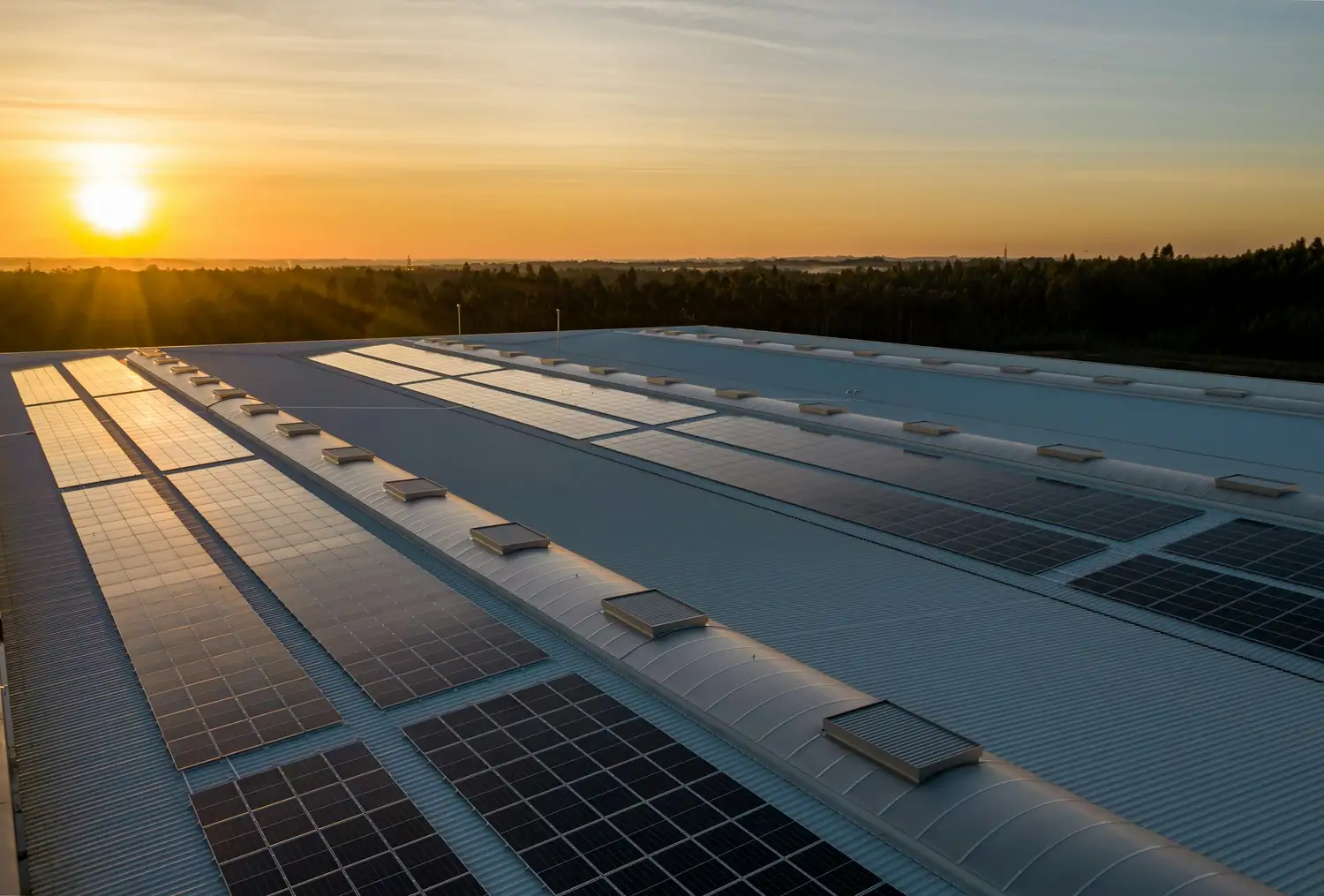
BIPV (building integrated photovoltaics) is solar that forms part of the building itself: the roof, the wall, the glass or the shading. It does two jobs, keeping the weather out and making power, so it replaces a material you would have bought anyway. Expect to pay more than for standard panels, and expect a south-facing wall to make around 70% of what a well-angled roof makes.
BIPV vs BAPV: what’s the difference?
- BAPV (building applied photovoltaics) means standard panels fixed on top of a finished roof. This is what most business roofs have.
- BIPV means the solar is the roof, wall or glazing. Take it away and you have a hole in the building.
BAPV is cheaper per kW. BIPV makes sense when you are building or re-roofing anyway, or when looks matter.
The main types of BIPV
- In-roof solar. Panels sit in the roof plane on a tray, in place of tiles or slates. Flatter and neater than on-roof panels.
- Solar roof tiles and slates. Small solar units laid like tiles or slates.
- Solar facades and cladding. Panels used as the outer skin of a wall. They can be coloured, printed or patterned so they don’t look like solar panels.
- Solar glass and glazing. Glass with solar cells built in, for curtain walls, skylights and atria. Cells can be spaced out to let daylight through.
- Balustrades and brise-soleil. Solar glass in balcony or walkway rails, and solar louvres (brise-soleil) that shade windows and cut overheating.
- Canopies and walkways. Solar glass or panels as the roof of an entrance canopy, covered walkway or pergola. See our guide to solar carports.
Solar landscaping: beyond the building
Solar can also be part of the outside space:
- Pergolas and shelters. Bike shelters, bin stores and smoking shelters with solar roofs.
- Benches and small structures with a solar top, often for phone charging or lighting.
- Low ground-mounted arrays kept below a hedge line and screened by planting.
- Vertical solar fences. Two-sided panels standing upright, often facing east and west, so they make power in the morning and evening. They work as a boundary or screen. Vertical solar panels and solar fences, and what we do.
Small freestanding arrays at business premises can be permitted development (no planning application), but the limits are tight: one array, no more than 9 square metres of panels, 4 metres high and 5 metres from the boundary. Anything bigger usually needs planning permission. More in ground-mounted solar and planning.
How much does BIPV cost?
There is no reliable UK price list. Every project is bespoke. What we can say:
- Per kW, it costs more than standard panels. Custom sizes, colours and glass cost more to make and fit.
- Part of the cost is offset by the roof, cladding or glass you no longer buy.
- A 2021 Swiss study of five buildings found integrated solar roofs and facades cost roughly 30 to 50% more than the same roof or wall finished in the usual way. One solar roof cost 41% more than fibre cement slate. That is Swiss, not UK, but it gives a sense of scale.
Get a cost for the whole wall or roof, not just the solar part. That’s the fair comparison.
How much power does a solar wall make?
Less than a roof. Walls are vertical and more likely to be shaded by trees and other buildings. Modelled figures for Exeter, per kW of panels:
| Position | Power a year (kWh per kW) | Compared to the best roof |
|---|---|---|
| South roof, tilted 35° | about 1,050 | 100% |
| South-facing wall | about 755 | about 72% |
| East or west-facing wall | about 530 | about 50% |
Source: PVGIS (EU Joint Research Centre), 14% system losses, no shading.
Coloured or patterned panels make less again, because some light is blocked. Ask the maker for the output of the actual product.
Fire and building regulations for solar facades
This is the big one for walls. These are the rules in England:
- Relevant buildings over 18m. Buildings with a storey at least 18m up that contain flats, a hospital or care home, student rooms, a boarding school dorm, or hotel and hostel rooms are covered by a ban on combustible materials in external walls.
- Solar panels are named. The Building Regulations list “a solar panel attached to an external wall” as a specified attachment. Its materials must reach Class A1 or A2-s1,d0, the top two fire classes. Many standard panels contain plastic layers, so check the fire class with the maker.
- Other buildings. Below 18m, or for offices and warehouses, Approved Document B still applies. External walls must resist fire spread, and distance to the boundary matters.
- Rules are moving. In spring 2026 the Building Safety Regulator consulted on reviewing the scope of the ban. At the time of writing no decision has been published. Check the current rules before you design.
Talk to your fire engineer and building control early, before the facade is fixed. In-roof kits also need fire testing as part of the roof. Read our commercial solar fire safety guide.
Maintenance and warranty
- Two warranties. Check both the power output warranty and the warranty for the building part (weathertightness, glass, fixings).
- Replacing a unit. A custom-sized or coloured panel may be hard to match in 15 years’ time. Ask about spares.
- Access. Facades and skylights need safe access for cleaning and repairs. Plan it at design stage.
Planning: heritage and conservation areas
BIPV can help where planners care about looks:
- Historic England says panels hidden from view, or on less prominent roof slopes, are generally acceptable on listed buildings. Black frames and non-reflective finishes help.
- Solar slates may suit low-visibility slopes during a re-roof, but Historic England warns they rarely look like real slate and can be harder to replace. Listed building consent is always needed on a listed building.
- Coloured and low-profile panels can reduce visual impact in conservation areas.
For non-domestic rooftops in England, solar is usually permitted development, with prior approval over 50kW. See rooftop solar and prior approval. Wall-mounted solar is more limited. Permitted development only covers small systems (up to 50kW), and not on a wall facing a road in a conservation area. A larger facade will need planning permission, which a new build will be going through anyway.
When does BIPV make sense?
- New builds. The solar replaces cladding, roofing or glass in the budget.
- Re-roofing. In-roof solar can go in while the roof is open.
- Listed or sensitive settings, where standard panels would be refused.
- When the roof is full. A south or west wall, a canopy or shading can add more.
If you have a large, sound roof and only want low-cost power, standard panels are usually better value. See how commercial solar is designed.
What we do
We design commercial solar and check planning and the grid connection before you commit. Installs are delivered with certified partner installers.
Solar facades: what we do → · Get a commercial solar quote →
Sources
- legislation.gov.uk: Building Regulations 2010, regulation 7 (combustible materials)
- HSE / Building Safety Regulator: review of Approved Document B (2026)
- legislation.gov.uk: GPDO 2015, Schedule 2, Part 14 (Classes J and K)
- Historic England: Adapting Historic Buildings for Energy and Carbon Efficiency (Advice Note 18)
- PVGIS: EU Joint Research Centre solar calculator
- pv Europe: Swiss study on the cost of solar facades and roofs (2021)
Facts last checked 25 October 2026. Every building is different. This is general information, not fire engineering, building control or legal advice.